A brake drum (or wheel drum) is a cylindrical cast iron component that rotates with the wheel in a drum-brake system, providing the surface the brake shoes press against to slow or stop the vehicle. Wheel drums are used in every vehicle, particularly cars and trucks, and cast iron is chosen specifically for its heat conductivity and wear resistance. A brake drum painting booth is built around handling these heavy castings safely and painting them consistently at volume. This guide covers the cleaning, handling, painting and finishing steps. For the product itself, see our wheel drum paint booth page.
📋 What This Guide Covers
- What is a brake drum painting booth?
- Pre-paint cleaning: copper brush & air blowing
- Monorail lifting vs roller conveyor handling
- How conveyorised brake drum painting works
- Spray equipment and air quality
- Paint, primer and finish
- Drying: air-dry vs oven-assisted
- Why this needs a dedicated booth
- Cost and what drives it
- Buyer checklist
1. What is a brake drum painting booth?
A brake drum painting booth is a spray booth designed specifically for wheel drums and brake drums - after the casting is manufactured, cooled and machined, it is cleaned and painted before dispatch. Because drums are heavy, produced in volume, and need a consistent finish across every unit, the booth is built around material handling as much as around the spray process itself.

2. Pre-paint cleaning: copper brush & air blowing
Once a drum is manufactured, cooled and machined, it is cleaned thoroughly with a copper brush and air blowing to remove loose debris and machining residue before it goes anywhere near paint. This step matters because any contamination left on the casting surface shows up as a defect once the drum is painted.
3. Monorail lifting vs roller conveyor handling
Autocoat offers two handling approaches for moving heavy drums through the painting process:
Monorail lifting method
An integrated monorail system lifts and lowers the wheel drum, keeping it at eye level and letting the painter work without bending. This suits lower-volume or mixed-size production where flexibility matters more than raw throughput.
Roller conveyorised brake drum painting
Drums move continuously through the booth on a roller conveyor, suited to higher-volume, more standardised production runs. See the next section for how this actually works on the floor.
4. How conveyorised brake drum painting works
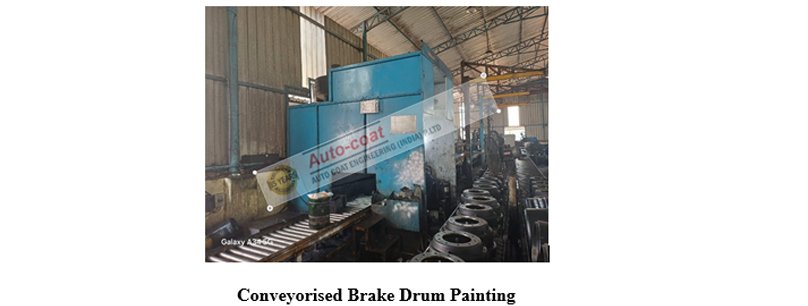
Drums are placed on a manual roller conveyor and pushed one by one into the paint booth. Each drum is then slid onto a turntable and rotated - manually or electrically - while the painter applies the spray gun, which gives an even paint film across the whole surface. Once painted, the drum is pushed to the far side of the conveyor to dry before being taken off the line.
5. Spray equipment and air quality
Brake drum painting needs a pilot spray gun, air hoses and an air compressor fitted with an FRL unit (filter-regulator-lubricator). The FRL unit removes water moisture from the compressed air before it reaches the spray gun - without it, moisture carried in the air stream can disturb the paint film as it is applied.
6. Paint, primer and finish
Most manufacturers of wheel drums use black paint in a matte finish, applied over a primer coat for adhesion. The primer-then-topcoat sequence is standard practice across the castings Autocoat paints for this application.
7. Drying: air-dry vs oven-assisted
Not every line needs an oven. Some manufacturers use ovens to dry the paint film on wheel drums, but good quick-drying paints can dry without oven assistance. Autocoat guides customers on whether an oven is needed depending on the paint system chosen - adding one where it isn't necessary just adds cost and floor space for no real benefit.
8. Why this needs a dedicated booth
A brake drum painting booth earns its keep on three fronts: it protects the operator and the environment from overspray at volume, it gives a consistent finish across every drum rather than relying on manual technique alone, and it handles the physical weight of cast iron drums safely - either through a monorail hoist or a roller conveyor - instead of expecting staff to lift and turn castings by hand all shift. With the growth in automotive production volumes, a dedicated booth has become a practical necessity rather than a nice-to-have for operator safety and environmental compliance.
9. Cost and what drives it
Autocoat does not publish a fixed price for a brake drum painting booth because cost depends on:
- Monorail hoist versus roller-conveyorised line
- Drum size, weight and shift-wise production volume
- Turntable and rotation automation (manual vs electric)
- Whether oven-assisted drying is required
- Filtration and spray booth size
Send your drum dimensions, weight and shift-wise volume for an exact quotation.
10. Buyer checklist
Before you order a brake drum painting booth
- Drum size, weight and shift-wise production volume
- Monorail lifting or roller-conveyorised handling, matched to your volume
- Primer and topcoat system confirmed with your paint supplier
- Oven drying needed, or a quick-drying paint system instead
- Compressed air supply with an FRL unit for moisture-free spraying
- Commissioning tests: a trial spray run and finish inspection on sample drums
Setting Up a Brake Drum Painting Line?
Send your drum size, weight and shift-wise volume. Autocoat's engineers will recommend monorail or conveyorised handling and send a budget quotation.
Get Free Quote →Frequently Asked Questions
What is a brake drum painting booth?
A spray booth built to clean and paint wheel drums and brake drums after manufacturing and machining, before dispatch.
Why can't brake drums use a generic paint booth?
They are heavy cast iron castings handled in volume, so the booth is built around lifting and moving them safely - via monorail hoist or roller conveyor - not manual loading.
How are brake drums cleaned before painting?
Thoroughly cleaned with a copper brush and air blowing after manufacturing, cooling and machining.
What is the difference between monorail and conveyorised brake drum painting?
Monorail lifts and lowers drums to eye level for the painter; conveyorised lines move drums continuously on a roller conveyor for higher volume.
How does a conveyorised brake drum line work?
Drums are pushed on a roller conveyor into the booth, slid onto a turntable and rotated while sprayed, then pushed on to dry.
What paint colour and finish is standard?
Black paint in a matte finish, over a primer coat for adhesion.
Does a brake drum need a primer coat?
Yes - applied before the black topcoat to improve adhesion and durability.
What spray equipment does brake drum painting need?
A pilot spray gun, air hoses and an air compressor with an FRL unit to remove moisture from the compressed air.
Do painted brake drums need oven drying?
Not always - some paints dry well without an oven. Autocoat advises based on the paint system chosen.
What does a brake drum painting booth cost?
Depends on handling method, drum size/weight, volume and whether an oven is needed - send details for an exact quotation.

About the Author
Umesh Prabhu — Founder & Managing Director, Autocoat Engineering India Pvt Ltd
Umesh Prabhu is a mechanical engineer, industrial consultant, and founder of Autocoat Engineering India Private Limited. With over 40 years of experience in industrial painting and surface finishing, he specializes in industrial paint shops, powder coating systems, automated painting solutions, paint booths, and energy-efficient plant design. His industry experience includes working with leading automotive and manufacturing companies such as Tata Motors and Bajaj Auto.
Connect on LinkedIn